As climate change intensifies droughts, disrupts rainfall patterns and fuels wildfires, more regions are turning to the sea for drinking water.
Desalination, which is the process of removing salt from seawater, offers a way to produce freshwater in regions that lack sufficient rain, rivers or groundwater to meet demand. Today, it supplies water to hundreds of millions of people worldwide, from the Middle East to the U.S., and its use is growing as water scarcity deepens.
Here’s what you need to know.
How it works
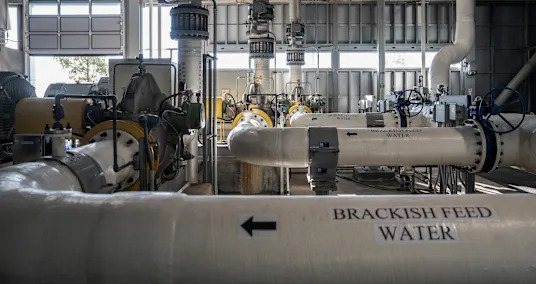
Most modern desalination plants rely on a process known as reverse osmosis. Seawater is forced at high pressure through a semi-permeable membrane that allows water molecules to pass through while blocking most salts and other impurities. The result is freshwater on one side and a highly concentrated salt solution, known as brine, on the other.
Before the water reaches the membrane, the seawater is typically filtered to remove debris and microorganisms that could clog equipment. Afterward, the freshwater is treated again to meet drinking water standards, often including the addition of minerals.
An older method, thermal desalination, involves heating seawater until it evaporates, then condensing the vapor back into liquid, leaving the salt behind. While still used in some regions, it is generally more energy intensive.
Where it's most commonly used
In the Middle East, countries such as Kuwait and Oman source more than 85% of their drinking water from desalination, according to a 2022 report by the French Institute of International Relations think tank.
It’s also widely used in parts of Africa and Australia, as well as in the U.S., particularly in drought prone coastal areas like California and Texas. In some Pacific Island nations, where rising seas have contaminated groundwater with salt, desalination is becoming an increasingly important source of freshwater.
More than 20,000 desalination plants now operate worldwide, and the industry has been expanding at about 7% annually since 2010, according to the International Desalination and Reuse Association.
Desalination comes with significant trade offs
The process is energy intensive, with plants worldwide producing between 500 and 850 million tons of carbon emissions annually, according to a 2025 study published in the journal Water Research. That's nearing the roughly 880 million tons emitted by the entire global aviation industry, an estimate from industry group Air Transport Action Group.
The byproduct of desalination, highly concentrated brine, is typically discharged back into the ocean, where it can harm seafloor habitats and coral reefs by increasing salinity and introducing chemicals used during treatment. Meanwhile, intake systems can trap and kill fish larvae, plankton and other organisms at the base of the marine food web — losses that can ripple outward, reducing populations of fish and larger predators that depend on them.
Efforts to reduce environmental impacts
Some companies are powering plants with renewable energy, while others are developing more efficient membrane technology to reduce energy consumption. Others are experimenting with moving the process into the deep sea, where natural ocean pressure can help drive reverse osmosis, lowering the need for additional energy.
Many experts say water recycling and conservation should come first, noting wastewater purification typically uses far less energy than seawater desalination and can substantially reduce impacts on marine life.
___
Follow Annika Hammerschlag on Instagram @ahammergram.
___
The Associated Press receives support from the Walton Family Foundation for coverage of water and environmental policy. The AP is solely responsible for all content. For all of AP’s environmental coverage, visit https://apnews.com/hub/climate-and-environment
LATEST POSTS
- 1
 An Extended time of Careful Nurturing: Individual Bits of knowledge on Bringing up Youngsters
 - 2Find the Mysteries of Effective Objective Setting: Transforming Dreams into Feasible Targets
- 3'Harmonious' meeting between Merz, Lula despite Belém controversy
- 4The most effective method to Safeguard Your Teeth from Acidic Food varieties and Beverages
- 5Curl Up With Some Hot Chocolate And Watch Mighty Car Mods Explore Japan In A Honda City Turbo II


- Starfront Observatories: A haven for distant stargazers
- Greenland’s melting ice and landslide-prone fjords make the oil and minerals Trump is eyeing dangerous to extract
- Volkswagen in talks with defence firms on use of Germany plant: CEO
- Key Training: Picking a Significant for Monetary Achievement
- Watch Blue Origin's huge New Glenn rocket ace its epic landing on a ship at sea (video)
- 10 Asian Countries Perfect for Solo Female Travelers
- A soft launch, an unfollow and a lot of questions: Breaking down the 'Summer House' romance blowing up group chats
- The most effective method to Guarantee Thorough Inclusion in Senior Protection.
- Flu cases skyrocket in US. See cases, where people got sick.