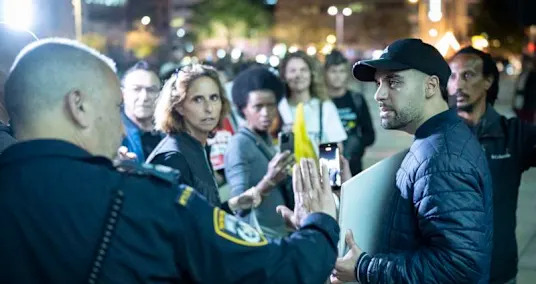
Protests took place in Tel Aviv, Jerusalem, Haifa, and Beersheba, as a survey found broad but uneven support among Jewish Israelis for Operation Roaring Lion.
Israel Police arrested 21 anti-war protesters Saturday night as demonstrations against the conflict with Iran expanded in multiple cities despite restrictions on public gatherings.
Protests took place in Tel Aviv, Jerusalem, Haifa, and Beersheba, with hundreds of participants reported in Tel Aviv and Jerusalem and about 100 in Haifa, marking the largest turnout since weekly demonstrations began. Authorities said 13 people were arrested in Tel Aviv and eight in Haifa.
Police said the gatherings were not approved under Home Front Command regulations that ban events with more than 50 people. Officials said the increase in turnout followed calls by groups opposing the government to protest despite the restrictions.
“During a situation assessment that took place at the scene with a Home Front Command representative… it was clarified that there was a real risk to human life and accordingly, Yarkon [precinct] police commander Tzachi Sharabi ordered the gathering to be dispersed,” police said.
Hadash-Ta’al chairman Ayman Odeh, an Arab lawmaker involved in the protests, criticized the police response, calling officers fascists “in the service of the government” and saying they were afraid of “the heroic citizens who went out, despite everything, to make their voice heard.”

Survey shows broad, uneven support for war
The demonstrations come as a March 2026 survey by the Israel Democracy Institute found broad but uneven support among Jewish Israelis for Operation Roaring Lion. Support was strongest on the Right at 87% and about half on the Left.
The survey also found that Jewish and Arab respondents largely agreed that Iran’s resilience has been stronger than expected. Most Jewish respondents said Israeli society could sustain the campaign for up to one month, while 28% said as long as needed. Arab respondents were less optimistic about how long the public could endure the conflict.
A majority of Jewish respondents said Prime Minister Benjamin Netanyahu’s decision was driven by security considerations, while most Arab respondents viewed it as political.
LATEST POSTS
- 1
 Exploring the School Application Cycle: Understudy Bits of knowledge
 - 2Artemis 2 astronauts — now halfway to the moon — report 'burning smell' from toilet, but everything's fine
- 3Dozens injured in Russia after train crashes, overturns
- 4Poll: 62% of Americans would oppose U.S. military action in Greenland
- 5Winona Ryder didn't take the 'Stranger Things' plot lightly. How 'otherworldly' grief and a kidnapping in her hometown informed her character.





- Turkey key underlying issue as Israel, Greece, Cyprus hold summit
- 4 well known subjects in school
- 10 Demonstrated Tips to Boost Your New Android Cell phone: A Thorough Aide
- Thousands of New York City nurses set to strike Monday if deal isn't reached with hospitals
- The 10 Most Famous Works of art Ever
- NI economy losing momentum due to Iran crisis
- Figure out How to Utilize Your Web based Advertising Degree to Break into the Tech Business
- Astrophotographer captures spectacular photo of Antennae Galaxies dueling in deep space
- Favored Chinese Dish: Make Your Determination